Search

Displaying 51 - 60 of 730

"Sheep Cloned by Nuclear Transfer from a Cultured Cell Line" (1996), by Keith Campbell, Jim McWhir, William Ritchie, and Ian Wilmut

By: Zane Bartlett | Published: Sep 19, 2014

In 1995 and 1996, researchers at the Roslin Institute in Edinburgh, Scotland, cloned mammals for the first time. Keith Campbell, Jim McWhir, William…

CloningClone CellsCloning, MolecularCloning, OrganismExperiments

Serial Cultivation of Human Diploid Cells in the Lab (1958–1961) by Leonard Hayflick and Paul S. Moorhead

By: Christian H. Ross | Published: Apr 27, 2017

From 1958 to 1961, Leonard Hayflick and Paul Moorhead in the US developed a way in the laboratory to cultivate strains of human cells with complete…

MMR VaccineRubellaRubella--VaccinationFetal tissuesOncogenic Viruses

“HeLa Cells 50 Years On: The Good, The Bad, and The Ugly” (2002), by John R. Masters

By: Rohini Nott | Published: May 02, 2021

Published in 2002, prostate cancer researcher John R. Masters authored a review article HeLa Cells 50 Years On: The Good, The Bad, and The Ugly that…

LiteratureCell linesContinuous cell linesGerm CellsSurface contamination

"The Developmental Capacity of Nuclei Taken from Intestinal Epithelium Cells of Feeding Tadpoles" (1962), by John B. Gurdon

By: Giselle Lee | Published: Mar 16, 2017

In 1962 researcher John Bertrand Gurdon at the University of Oxford in Oxford, England, conducted a series of experiments on the developmental…

Cell nuclei--TransplantationGenetic EngineeringNuclear TransplantationUniversity College (University of Oxford)Xenopus laevis

"Transplantation of Living Nuclei from Blastula Cells into Enucleated Frogs' Eggs" (1952), by Robert Briggs and Thomas J. King

By: Nicole Newkirk | Published: Nov 13, 2007

In 1952 Robert Briggs and Thomas J. King published their article, "Transplantation of Living Nuclei from Blastula Cells into Enucleated Frogs' Eggs…

Cell nuclei--TransplantationNuclear Transfer TechniquesExperimentsNuclear TransplantationTransplantation

The Development of the Neural Crest and the Migration of Neural Crest Cells (NCCs) in the Embryos of Various Vertebrates

By: Brian K. Hall | Published: Aug 21, 2014

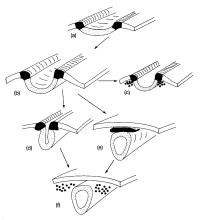
This diagram shows how NCCs migrate differently in rats, birds and amphibians.

Neural CrestEmbryosVertebratesGerm LayersEctoderm

"Programmed Cell Death-II. Endocrine Potentiation of the Breakdown of the Intersegmental Muscles of Silkmoths" (1964), by Richard A. Lockshin and Carroll M. Williams

By: Lijing Jiang | Published: Apr 27, 2011

Richard A. Lockshin's 1963 PhD dissertation on cell death in insect metamorphosis was conducted under the supervision of Harvard insect physiologist…

LiteratureExperimentsPublicationsSilkwormsHormones

“A Two-Factor Hypothesis of Freezing Injury: Evidence from Chinese Hamster Tissue-Culture Cells” (1972), by Peter Mazur, Stanley Leibo, and Ernest Chu

By: Risa Aria Schnebly | Published: Mar 02, 2021

In 1972, Peter Mazur, Stanley Leibo, and Ernest Chu published, “A Two-Factor Hypothesis of Freezing Injury: Evidence from Chinese Hamster Tissue-…

LiteratureCryonicsCryosurgeryMedicine--History--20th centuryOsmosis

"Developmental Capacity of Nuclei Transplanted from Keratinized Skin Cells of Adult Frogs" (1975), by John Gurdon, Ronald Laskey, and O. Raymond Reeves

By: Sean Cohmer | Published: Jun 14, 2011

In 1975 John Gurdon, Ronald Laskey, and O. Raymond Reeves published "Developmental Capacity of Nuclei Transplanted from Keratinized Skin Cells of…

Nuclear Transfer TechniquesExperimentsPublicationsFrogsNuclear Transplantation

"The Potency of the First Two Cleavage Cells in Echinoderm Development. Experimental Production of Partial and Double Formations" (1891-1892), by Hans Driesch

By: Megan Kearl | Published: Jan 01, 2012

Hans Adolf Eduard Driesch was a late-nineteenth and early-twentieth century philosopher and developmental biologist. In the spring of 1891 Driesch…


ExperimentsPublicationsSea Urchins